
Why novelty and accountability matter more than willpower
This past weekend, my sister-in-law visited. I spent the week cleaning, shopping, and preparing food.
My house is never as clean or organized as when company is coming.
Sound familiar?
For people with ADHD and executive function challenges, the difference between everyday life and “company is coming” life isn’t small — it’s a chasm. Dishes pile up. Papers stack up. Clutter quietly grows.
Honestly? Sometimes I look forward to inviting people over because it gives me the push I need to finally get things done.
And that says something important about ADHD motivation.
Why Motivation Feels Different With ADHD
Executive function is the brain’s management system. It helps us plan, prioritize, start tasks, sustain effort, and finish what we begin.
When executive function is challenged — whether due to ADHD or other factors — motivation doesn’t work the way most productivity advice assumes it should.
Most people are motivated by the reward of finishing a task.
People with ADHD are often motivated by something else entirely.
The ADHD Motivation Difference
ADHD brains respond most strongly to:
- Novelty
- Urgency
That’s it. That’s the pattern.
When something is new, interesting, or high-pressure, energy appears. Focus sharpens. Momentum builds.
When something is routine, distant, or low-stakes? The brain may simply not engage.
This isn’t laziness.
It isn’t a lack of caring.
It’s a different neurological wiring — one that is closely tied to how dopamine works in the ADHD brain.
Understanding this changes everything.
The “New Idea” Energy Surge
I notice this pattern in myself often.
When I have a new idea — a vacation plan, a work project, a creative spark — I feel energized. I research. I organize. I prep. I buy supplies.
But when it’s time to actually do the thing?
The energy is sometimes gone.
As a child, I did well in school — but I waited until the last minute to study or finish projects. I was the queen of all-nighters. The urgency worked… but it often meant rushed, lower-quality work and unnecessary stress.
This is classic ADHD task initiation difficulty paired with urgency-based motivation.
The Gadget Trap
Many of us try to manufacture motivation by buying supplies.
Someone wants to get healthy, so they buy workout clothes, weights, maybe even a spiralizer for veggie noodles.
It feels productive.
But are they actually healthier?
Usually not.
The novelty wears off. The gym visits slow down. The spiralizer is hard to clean. Zucchini noodles weren’t that exciting anyway.
Buying the tools gives us a dopamine hit. But tools are not the same as follow-through.
Working With Your Brain (Not Against It)
The goal isn’t more time.
It isn’t more discipline.
It definitely isn’t more shame.
It’s learning to use novelty and urgency in realistic, compassionate ways.
Small shifts — done consistently — can make a meaningful difference.
Novelty = Fun
Novelty doesn’t have to mean something brand new every day. That’s exhausting.
Instead, think: How can I make this a little more interesting or enjoyable?
Try:
- First ___, then ___
- First I work out, then I have a smoothie.
- First I clear the clothes off the chair, then I call a friend.
- Chunk a task and follow it with a small reward.
- Pair a boring task with something pleasant.
- Listen to an audiobook or music while cleaning or organizing.
- Change locations (work at a café, sit on the floor, move rooms).
We’re not tricking ourselves. We’re giving our brains the stimulation they naturally seek.
Urgency = Accountability (Without Panic)
Urgency can create stress, rushed work, and burnout.
But there’s a gentler version of urgency: accountability.
This is where external motivators for ADHD can be incredibly helpful.
Body Doubling
Body doubling is one of the most effective ADHD productivity strategies.
It works like this:
- Call a friend or family member.
- Tell them what you’re working on.
- Stay on the call while you both work.
- Share progress at the end.
You can also use scheduled body-doubling platforms like Focusmate, where you work quietly alongside someone else for a set period of time.
The presence of another person creates just enough urgency to help the brain engage — without crisis-level stress.

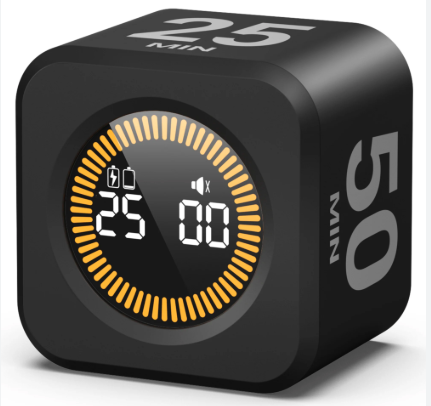
Visual Timers
Seeing time pass can be far more motivating than simply hearing an alarm.
A visual timer makes time tangible. It adds structure. It reduces the “time blindness” that often comes with ADHD.
A Gentle Note About Screens
If you struggle with excessive screen time, doomscrolling, or internet overuse, try to keep rewards and accountability strategies screen-free whenever possible.
The goal is regulation — not swapping one dopamine source for another.
The Bigger Shift
If you’ve ever wondered:
Why do I only work when there’s pressure?
Why do I start strong but struggle to finish?
Why does “company is coming” work better than my own deadlines?
You’re not broken.
Your brain is motivated differently.
When we understand that ADHD motivation runs on novelty and urgency, we can stop chasing willpower and start building supportive systems instead.
Small shifts.
Compassionate strategies.
External structure where needed.
That’s often enough to bridge the gap between intention and action.
And that gap?
It’s not a character flaw.
It’s an executive function difference — and it can be supported. 💛
