
You’re Not Forgetting Because You Don’t Care
Have you ever:
- Read something interesting… and then couldn’t explain it later?
- Studied for an hour… and blanked out the next day?
- Left a meeting thinking, “Wait… what are my action steps?”
That experience is common.
Over 100 years ago, Hermann Ebbinghaus demonstrated how quickly humans forget information when it isn’t reinforced.
The takeaway?
Forgetting is normal.
ADHD just makes certain parts of the memory process more vulnerable.
The Two Memory Trouble Spots
Most ADHD memory struggles show up in two stages.
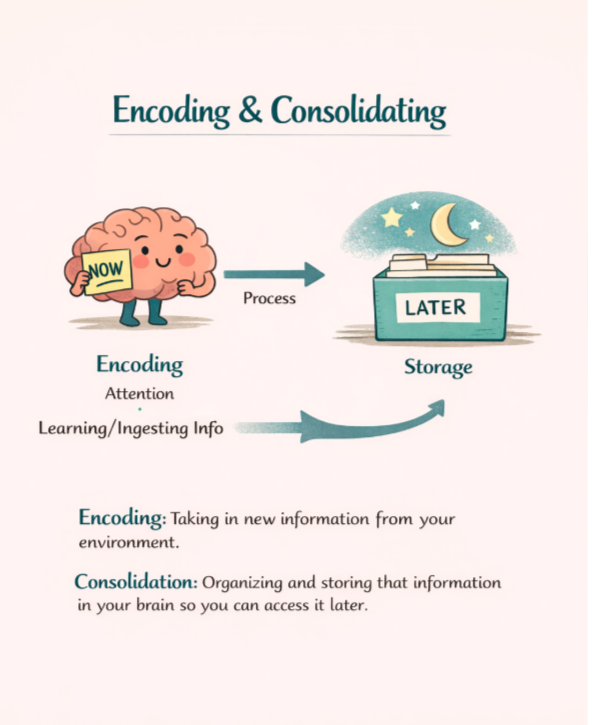
1. Encoding (Working Memory)
This is your brain’s “mental sticky note.”
It temporarily holds information while you use it.
Like:
- A two-factor code
- Directions from a teacher
- Verbal instructions in a meeting
Encoding requires attention.
And ADHD brains struggle to filter input.
That means while you’re trying to focus, your brain may also be tracking:
- Noise
- Internal thoughts
- Emotional stress
- Hunger
- That itchy sweater tag
- Poor sleep
If information isn’t clearly encoded…
It can’t move forward.
That’s not laziness.
That’s bandwidth.
2. Consolidation (Moving It Into Long-Term Memory)
After encoding, your brain decides:
“Is this important enough to keep?”
If yes, it consolidates the memory.
The Importance of Sleep
One of the biggest supports for consolidation?
Sleep.
Sleep:
- Strengthens learning
- Embeds memories
- Supports brain plasticity
When sleep is inconsistent or insufficient:
- Retention drops
- Focus decreases
- Learning feels harder
Many people with ADHD experience delayed sleep cycles or disrupted sleep.
So sometimes the issue isn’t effort.
It’s physiology.
Rest Isn’t Always the Answer for ADHD
For many people, learning followed by quiet rest improves memory.
But some individuals with ADHD retain information better after:
- Light movement
- Mild stimulation
- A short active break
Stillness doesn’t always regulate an ADHD nervous system.
Sometimes gentle activation works better.
That’s not defiance.
That’s neurobiology.
Timing Matters for Physical Skills
If you’re practicing:
- Sports
- Dance
- An instrument
- Any motor-based skill
Evening practice (closer to sleep) may support stronger next-day retention for people with ADHD.
Morning practice isn’t wrong.
But timing can make a difference.
Strategy reduces frustration.
Gentle Strategy Shifts to Try
Instead of “try harder,” try:
- Reduce distractions during learning
- Support food, water, and sleep
- Review sooner than you think you need to (after paragraphs, pages, etc.)
- Use brief movement breaks
- Externalize information (write it, record it, visualize it)
- Experiment with evening timing for physical practice
External supports are not cheating.
They are scaffolding.
Key Takeaways for ADHD Memory
ADHD memory challenges often happen during:
- Encoding (attention overload)
- Consolidation (self-care, study skills, + timing)
When we understand where the breakdown happens…
We start designing supports.
Your brain just needs conditions that match how it works.
If you’d like the full explanation with references, read:
We don’t fix memory with shame.
We improve it with understanding.