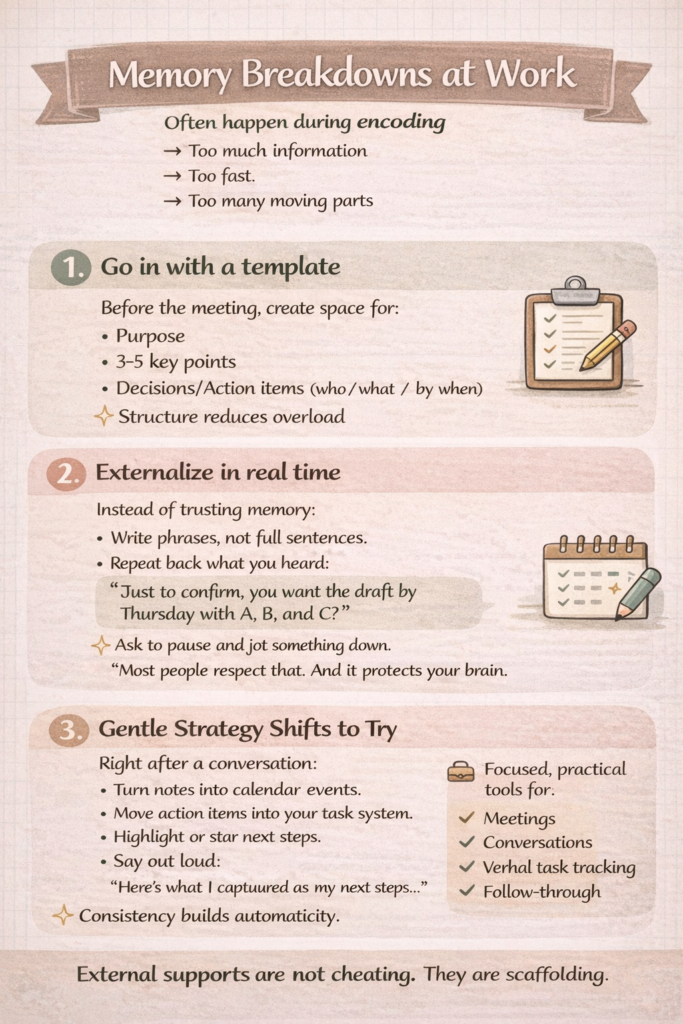

Memory breakdown at work often happens during encoding, when our brain gathers information into our working memory.
Too much information. Too fast. Too many moving parts.
Here are a few practical strategies from the workplace guide:
Go into meetings with a template
Before the meeting, create space for:
- Purpose
- 3–5 key points
- Decisions
- Action items (who / what / by when)
Structure reduces overload.
If you can’t listen and write/type at the same time, use an app that records, transcribes, and summarizes your meeting, such as Otter.AI or Viska Local.
In some states, everyone at the meeting must be told if they are being recorded.
Externalize in real time
Instead of trusting memory:
- Write phrases, not full sentences.
- Repeat back what you heard:
“Just to confirm, you want the draft by Thursday with A, B, and C?” - Ask to pause and jot something down.
Most people respect that.
And it protects your brain.
Use a 2-minute “after meeting” reset
Right after a conversation:
- Say out loud: “Here’s what I captured as my next steps…”
- Highlight or star next steps.
- Turn notes into calendar events.
- Move action items into your task system.
Consistency builds automaticity.
Because memory challenges don’t disappear after you grow up.
They just change environments.
Gentle Strategy Shifts to Try
Instead of “try harder,” try:
- Reduce distractions
- Support food, water, and sleep
- Review sooner than you think you need to
- Use brief movement breaks
- Externalize information (write it, record it, visualize it)
External supports are not cheating.
They are scaffolding.