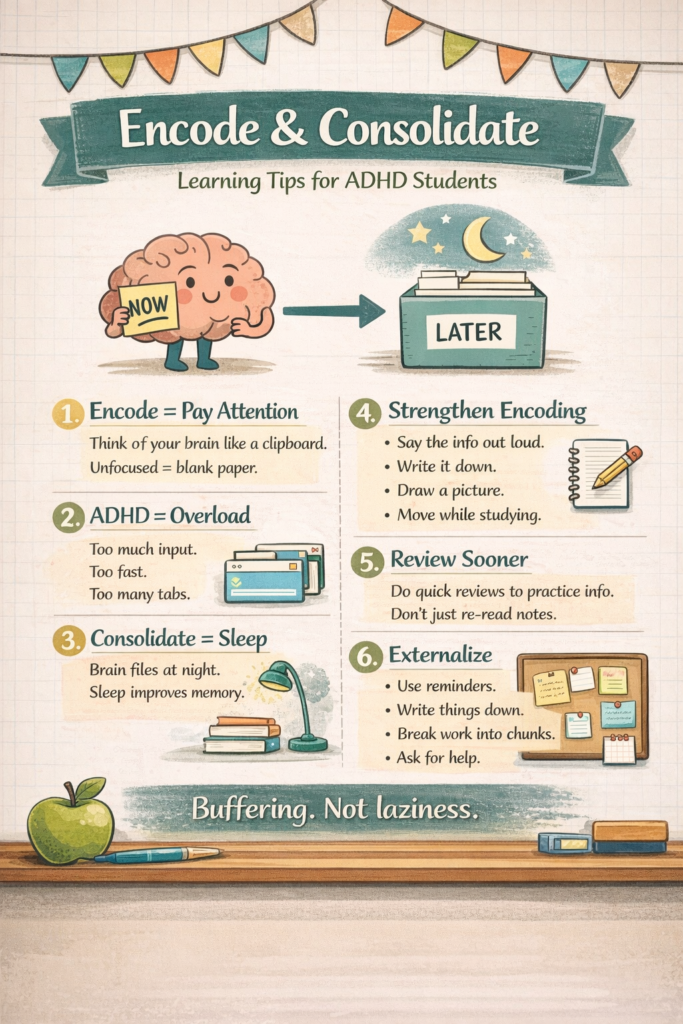

Understanding encoding and consolidation is helpful.
But what does that actually look like when you’re studying?
Here are a few strategies pulled from the full student guide:
Make learning multisensory
- Say key points out loud.
- Record quick voice notes and replay them while walking.
- Handwrite key ideas on paper or a whiteboard.
- Sketch diagrams or mind maps instead of rereading.
The more pathways you activate, the stronger the encoding becomes.
Study in short, strategic bursts
Instead of long study marathons:
- Use 10–15 minute focus blocks.
- Then close your notes.
- Write or say what you remember in your own words.
- Compare and fill in gaps.
That recall step strengthens consolidation.
Reduce working memory load while studying
Your brain can’t encode well if it’s juggling everything.
Try:
- Keeping a scrap sheet nearby for random thoughts.
- Using a predictable study setup (same spot, minimal tabs).
- Color-coding main ideas vs. examples.
- Skimming first and identifying 3–5 big takeaways.
We’re building structure so your working memory doesn’t have to carry everything alone.
Gentle Strategy Shifts to Try
Instead of “try harder,” try:
- Reduce distractions during learning
- Support food, water, and sleep
- Review sooner than you think you need to (after every paragraph, page, etc.)
- Use brief movement breaks
- Externalize information (write it, record it, visualize it)
- Experiment with evening timing for physical practice
External supports are not cheating.
They are scaffolding.
Key Takeaways for ADHD Memory
ADHD memory challenges often happen during:
- Encoding (attention overload)
- Consolidation (self care, study skills, + timing)
When we understand where the breakdown happens…
We start designing supports.
Your brain just needs conditions that match how it works.