
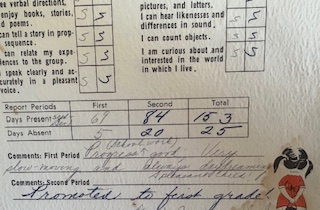
I found my kindergarten report card the other day.
One comment stood out:
Progress (schoolwork) is good. Very slow-moving. Always daydreaming. A pleasant child.
I smiled when I read it.
Looking back, the signs were already there.
What Inattentive ADHD Can Look Like
I have what’s now called Inattentive ADHD (previously ADD).
This type is easy to miss.
These are often the students who:
- Don’t disrupt the class.
- Aren’t seen as “behavior problems.”
- Seem quiet or lost in thought.
They’re often:
- Daydreaming.
- Missing part of the directions.
- Asking a question that was just answered.
Because they’re not disruptive, they’re often overlooked.
When Strengths and Challenges Coexist
Things can get more complicated if you’re also gifted.
You might hear the term twice exceptional (2e).
That means:
- Strong abilities and real challenges at the same time.
You might:
- See patterns quickly.
- Think creatively.
- Solve complex problems.
And still struggle with:
- Organization.
- Planning.
- Time management.
- Prioritizing.
- Managing frustration or anxiety.
Sometimes your strengths hide your struggles.
Sometimes your struggles hide your strengths.
The Messages That Stick
Growing up, I heard things like:
- “You’re not living up to your potential.”
- “You’re smart, but lazy.”
- “You’re always daydreaming.”
- “You never finish what you start.”
- “I already answered that.”
Those messages add up.
What It Looked Like for Me
I wasn’t diagnosed until middle age.
Once I learned about Inattentive ADHD, things started to make sense.
Here’s what it looked like across my life:
- Elementary school:
I understood complex math, but forgot small steps like carrying numbers (regrouping). - High school:
Algebra was the first class I struggled with. My anxiety got so intense that it affected my health. - College (music):
I could analyze complex pieces, but made simple mistakes when transposing. I was so afraid of failure that I suffered from crippling performance anxiety. - Practice time:
I got frustrated quickly, couldn’t stay with it, and avoided practicing. That made the cycle worse.
I wasn’t careless. I was overwhelmed.
Why Twice Exceptional Students Get Missed
Twice exceptional students are often misunderstood.
- Their strengths make them look capable.
- Their challenges look like lack of effort.
So they may not get support for either.
Over time, this can lead to:
- Low self-esteem.
- Anxiety.
- Underachievement.
If This Sounds Familiar
If you’re seeing this in your child:
- Talk with their teacher.
- Talk with the school counselor.
- Ask questions early.
Early support matters. It can change how a child sees themselves.
If this sounds like you:
It’s not too late.
Understanding how your brain works can change how you approach everything:
- Learning.
- Work.
- Daily life.
And it can replace years of confusion with clarity.